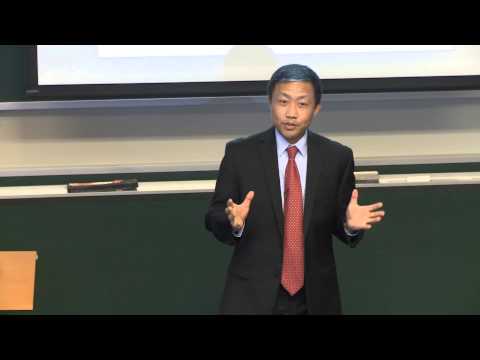
Introductory Calculus: Oxford Mathematics 1st Year Student Lecture
Oxford Mathematics
Summary
The first lecture of an Oxford Introductory Calculus course provides practical information, outlines the syllabus focusing on differential equations and integration, and reviews fundamental techniques for solving both.
Key Takeaways
- Course Structure: The course comprises 16 lectures (twice weekly), covers 8 problem sheets, and includes 4 college tutorials. 2:06
- Recommended Text: The primary recommended book is Mary Boas's "Mathematical Methods in Physical Sciences," valued for its conciseness and relevant examples from physics and engineering. 2:51
- Syllabus First Half: Approximately the first 7-8 lectures are dedicated to ordinary differential equations (ODEs) and partial differential equations (PDEs), focusing on techniques to solve fairly easy examples. 4:13
- Syllabus Second Half: Following differential equations, the course covers line and double integrals (about 3 lectures) for calculating arc lengths and areas, concluding with an introduction to multivariable calculus, including gradients, Taylor's theorem in two variables, and Lagrange multipliers. 5:26
- Intercourse Connections: This introductory calculus course serves as foundational groundwork directly useful for other preliminary courses such as Multivariable Calculus, Dynamics, Analysis 2, and later applied mathematics options in Part A. 7:12
- Ordinary Differential Equations (ODEs): An ODE is an equation involving an independent variable (x), a dependent function of x (y), and its derivatives with respect to x, with the order defined by the highest derivative present. 9:26
- Integration by Parts: This fundamental integration technique, derived from the product rule (∫ f g' dx = fg - ∫ f' g dx), is crucial for solving various integrals and is reviewed with examples like ∫ x^2 sin(x) dx. 22:31
- Recursive Formulas: For certain integrals, such as ∫ cos^n(x) dx, a recursive or reduction formula can be derived, expressing I(n) in terms of I(n-2), which requires knowing I(0) and I(1) to find a general solution. 36:00
- Separable Differential Equations: Differential equations of the form dy/dx = a(x)b(y) are called separable and can be solved by rearranging terms to integrate 1/b(y) dy = a(x) dx, reducing the problem to direct integration. 45:23
- Caution with Division by Zero: When solving separable differential equations by dividing by b(y), it's critical to consider cases where b(y) might be zero, as these can represent valid constant solutions that would otherwise be missed. 57:17