Summary
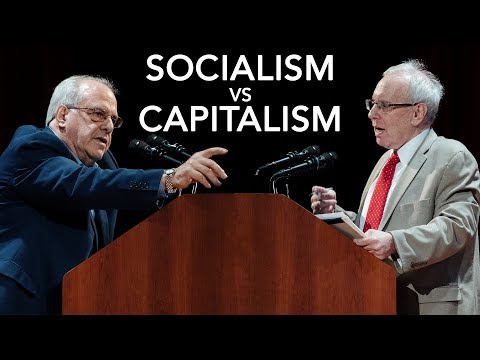
The debate centers on whether socialism is preferable to capitalism in promoting freedom, equality, and prosperity, with Richard Wolff arguing for a new, democratized workplace-focused socialism and Gene Epstein defending a freedom-loving capitalism while acknowledging its current flaws due to government interference.
Key Takeaways
- Socialist Critique of Capitalism: Capitalism is fundamentally unstable, unequal, and undemocratic, characterized by recurring economic downturns every 4-7 years, extreme wealth concentration (e.g., 80-90 richest people having more wealth than the bottom half of the world), and a lack of democracy in the workplace where owners/managers act as "kings" making all key decisions. 10:16
- New Socialism's Focus: Unlike past state-centric socialist experiments (e.g., Russia, China, Cuba), the "new socialism" aims to democratize the workplace, giving all workers in an enterprise a say in what, how, and where to produce, and what to do with profits, addressing power imbalances directly at the base of society. 16:29
- Capitalism's Potential for Worker-Owned Firms: Gene Epstein argues that worker self-directed enterprises (WSDES), where employees own and democratically run companies, are entirely compatible with capitalism, as the system of private property rights doesn't dictate firm structure, and workers are free to choose such arrangements. 22:34
- Challenges for Worker-Owned Firms: Despite the potential, Epstein notes that worker-owned enterprises are "almost impossible to get off the ground" without coercive government power, and workers rarely choose to transform enterprises into fully democratically directed ones, suggesting a lack of worker interest. 24:48
- Socialism's Threat to Freedom: Epstein contends that Wolff's proposed system of socialized finance and labor allocation agencies, which would "always know" and monitor workers and enterprises, would lead to a tyranny of the majority, potentially stifling dissenting journalism or personal choices (e.g., birth control) if not approved by the majority vote. 30:07
- Role of Government and Markets: Wolff argues that capitalism's history of struggle for shorter working hours and child labor laws demonstrates that "choice" isn't a simple libertarian ideal but a battle against capital's drive for surplus, and markets are not unique to capitalism (slavery and feudalism also had markets); capitalism's defining feature is the employer-employee production organization. 1:16:41
- Socialism as Capitalism's Self-Criticism: Wolff views socialism as the inherent "shadow of capitalism," capitalism's continuous self-criticism, implying that as long as capitalism exists, socialism will emerge in response, evolving and learning from past experiments just as capitalism itself took centuries to develop. 1:18:23
- The Corbyn Plan and Expanding Choice: Richard Wolff cites Jeremy Corbyn's UK Labour Party proposal where, if elected, a law would give workers the right of first refusal to buy their company (with government loans) if it's shutting down, moving, or selling, arguing this expands free choice for people to experience both capitalist and worker-cooperative models. 1:29:00
- Capitalism's Record of Prosperity: Epstein counters that historical controlled experiments (e.g., East vs. West Germany, North vs. South Korea, Taiwan/Hong Kong vs. China before liberalization) demonstrate capitalism's superior track record in creating affluence and democratic societies compared to state socialism. 1:32:13