Summary
AI image and video generation models, primarily using diffusion, operate by iteratively transforming pure noise into realistic content, guided by a shared embedding space learned through contrastive training (like CLIP) and enhanced through techniques like classifier-free guidance.
Key Takeaways
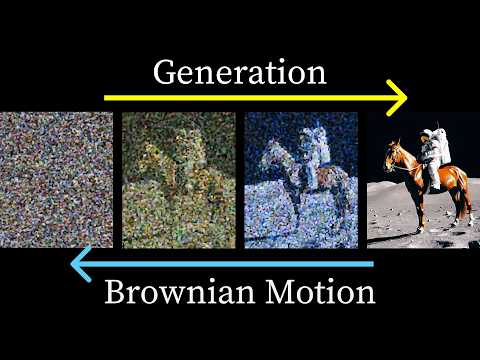
- Diffusion Process: Modern AI image and video models generate content through a process called diffusion, which is mathematically equivalent to running Brownian motion backwards in a high-dimensional space, iteratively shaping pure noise into realistic visuals. 0:03
- Iterative Noise Shaping: The video generation process starts with random pixel noise, which is then passed into a transformer model repeatedly (e.g., 50 iterations), with the transformer gradually adding structure and realism at each step. 1:25
- CLIP's Shared Embedding Space: OpenAI's CLIP model, trained on 400 million image-caption pairs, consists of a language and a vision model that learn a shared 512-dimension vector space where related images and text align, allowing for mathematical operations on concepts (e.g., subtracting "no hat" from "hat" yields a "hat" vector). 3:58
- DDPM Training Objective: Denoising Diffusion Probabilistic Models (DDPM) are trained by adding scaled random noise to an initial clean image (X0) and then teaching the model to predict the total noise added to the original image, rather than just denoising one step at a time, which significantly reduces training variance. 10:41
- Importance of Added Noise (DDPM): During image generation, DDPM algorithms require adding random noise at each step of the reverse diffusion process; removing this noise results in blurry, averaged images because the model, without this noise, tends to converge to the mean of the data distribution. 10:03
- Faster Deterministic Generation (DDIM): Approaches like Denoising Diffusion Implicit Models (DDIM) offer a deterministic method to generate high-quality images in significantly fewer steps than DDPM, achieving the same final distribution of images by using an ordinary differential equation without random noise components. 22:52
- Classifier-Free Guidance: To achieve strong prompt adherence in models like DALL-E 2 or Stable Diffusion, a technique called classifier-free guidance is essential; it involves training a model to simultaneously produce conditioned (e.g., "tree") and unconditioned (general data) outputs, then amplifying the difference to steer the generation process more strongly towards the desired features. 29:44
- Negative Prompts: An advanced form of guidance used in models like WAN takes classifier-free guidance a step further by using "negative prompts" – specifically listing features to avoid in the output video, and then subtracting the vector associated with these unwanted features from the conditioned output. 33:41