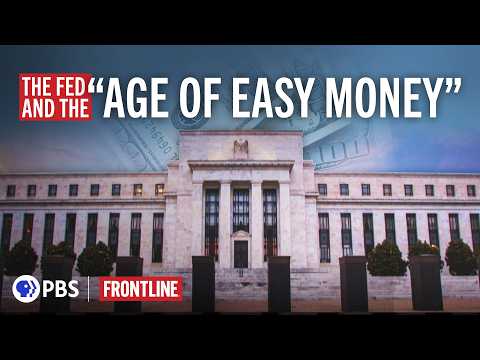
Age of Easy Money (full documentary) | FRONTLINE
FRONTLINE PBS | Official
Summary
The era of "easy money" policies, initiated by the Federal Reserve after the 2008 financial crisis, dramatically reshaped the U.S. economy by fueling asset bubbles, exacerbating wealth inequality, and creating systemic vulnerabilities, ultimately leading to a rapid and painful tightening cycle in response to post-pandemic inflation and exposing deeper, unresolved political and economic challenges.
Key Takeaways
- Initial Policy & Unintended Consequences: The Federal Reserve's quantitative easing (QE), launched after the 2008 crisis as an emergency measure to prevent financial collapse, became the cornerstone of "easy money" and was quickly exploited by banks which invested in the same bonds the Fed was buying, rather than lending to the real economy as intended. 14:27
- Deepening Inequality & Corporate Behavior: This easy money era exacerbated wealth inequality by disproportionately boosting asset prices, primarily benefiting the wealthy, and incentivized corporations to use cheap debt for massive stock buybacks (over $6 trillion post-2008) to inflate share prices and executive bonuses, rather than investing in growth or workforce. 43:47
- Shift in Central Bank Mandate & Moral Hazard: Due to political paralysis post-2010, the Fed increasingly became the primary engine of economic growth, a role traditionally reserved for democratic institutions. This, coupled with repeated bailouts and interventions, fostered a "moral hazard" where markets expected central bank action to prevent losses from aggressive, risky bets. 20:07
- Vulnerabilities in Shadow Banking: Easy money policies facilitated a significant migration of financial risk to largely unregulated "shadow banks" (e.g., asset management companies, hedge funds) operating outside traditional banking supervision, creating systemic fragility that proved vulnerable to external shocks, as demonstrated during the COVID-19 pandemic. 51:07
- "Transitory" Miscalculation & Inflation: The Fed initially misjudged the post-pandemic inflation surge in 2021 as "transitory," maintaining easy money policies for too long despite warnings, which led to a rapid, aggressive tightening cycle that is now causing significant economic pain and household distress as prices and interest rates rise. 1:18:52
- The Unavoidable Reckoning: The current environment marks a "once in a lifetime financial transition" away from ultra-low interest rates. This shift is exposing deep vulnerabilities, as seen with the Silicon Valley Bank collapse, and foreshadows a potential debt crisis as highly leveraged households, businesses, and governments face rising interest costs. 1:42:40
- Beyond Monetary Policy: Many experts argue that the extensive reliance on the Fed for economic growth highlights a fundamental political problem: democratic institutions have failed to enact necessary fiscal policies (e.g., infrastructure investment, education reform) during periods of cheap money, leaving the Fed to create artificial, unsustainable growth that it cannot fundamentally fix. 1:51:28