
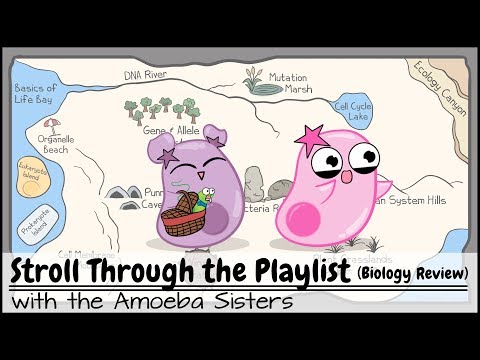
Stroll Through the Playlist (a Biology Review)
Amoeba Sisters
Summary
This video serves as a comprehensive, brisk refresher of fundamental biology concepts, designed as a study tool to help viewers identify strengths and areas for deeper review by connecting various biological principles.
Key Takeaways
- Study Strategy: The video is structured as a "brisk stroll" through biology concepts, using frequent "pause" questions to prompt viewer recall and indicate when it might be beneficial to revisit a more detailed topic-specific video. 1:27
- Biological Organization: Life is organized hierarchically, starting from the cell as the smallest living unit, progressing through tissues, organs, organ systems, and individual organisms, then expanding to populations, communities, ecosystems, biomes, and the entire biosphere. 2:31
- Macromolecules: Living organisms are fundamentally composed of four major biomolecules—carbohydrates, lipids, proteins, and nucleic acids—each built from specific monomers like monosaccharides, fatty acids/glycerol, amino acids, and nucleotides, respectively. 3:44
- Cell Types and Transport: Cells are either prokaryotic (lacking a nucleus and membrane-bound organelles) or eukaryotic (possessing them), with all cells having a membrane crucial for homeostasis, regulating molecular movement via passive transport (diffusion, facilitated diffusion) or active transport (requiring ATP). 5:27
- DNA Replication: Making new body cells necessitates DNA replication, a process involving key enzymes like helicase (unwinds DNA), primase (lays down primers), and DNA Polymerase (builds new strands in the 5’ to 3’ direction), leading to the formation of leading and lagging strands with Okazaki fragments. 11:29
- Protein Synthesis: The production of proteins involves two primary steps: transcription, where mRNA is made from DNA in the nucleus, and translation, where mRNA is read by ribosomes to assemble a chain of amino acids (polypeptide), guided by three-base codons on the mRNA. 19:49
- Evolutionary Mechanisms: Natural selection drives evolution by favoring organisms with traits that increase reproductive fitness, leading to a higher frequency of those traits in a population over time, which differs from genetic drift, an evolutionary mechanism based on random chance events. 23:17
- Ecosystem Dynamics: Ecosystems function through the cycling of essential elements (e.g., carbon, nitrogen, water), the transfer of energy (with approximately 10% moving to the next trophic level), and various ecological relationships, including predation, competition, and symbiotic interactions like mutualism and parasitism. 34:40


