Summary
This introduction to psychology explores how human minds are shaped by innate tendencies, learning, and evolution, examining three case studies—compassion, racism, and sex—to reveal the complex interplay of conscious and unconscious processes that drive behavior.
Key Takeaways
- Brain's Computational Power: The human brain is an extraordinary computational machine, with a baby's brain creating approximately 1.8 million neural connections per second, underscoring its immense capacity for development and learning. 3:46
- Innate but Narrow Compassion: Humans possess an innate capacity for compassion and empathy, evident from infancy, but this moral circle is initially narrow, primarily extending to those in close proximity; default reactions to strangers can often be fear, hatred, and disgust. 5:56
- Expanding Compassion Through Individual Stories: To broaden one's moral circle and motivate altruistic action towards distant strangers, it is more effective to appeal through concrete individual stories and images rather than abstract statistics, which activate hardwired compassionate responses. 15:02
- Stereotypes: Adaptive but Problematic: Stereotypes are natural and often accurate statistical generalizations crucial for navigating the world, but they become problematic when based on unreliable information, lead to "stereotype threat" for affected individuals, or contribute to denigrating out-groups. 20:14
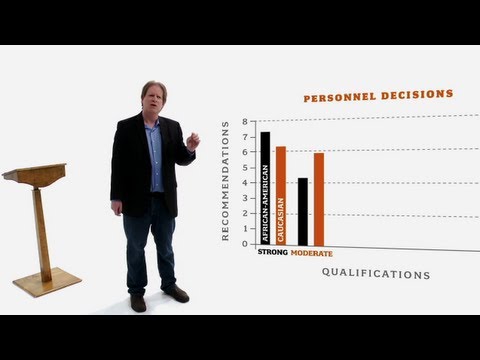
- Unconscious Bias vs. Conscious Egalitarianism: Humans maintain conscious egalitarian beliefs but also possess an unconscious, statistics-driven system prone to biases that can impact real-world decisions (e.g., hiring, split-second judgments) despite conscious intentions to be fair. 26:27
- Mitigating Bias via Environmental Design: Unconscious biases can be significantly reduced by structuring environments to remove biasing information, allowing individuals' "better selves" to make decisions, as exemplified by blind auditions in symphony orchestras increasing female representation. 29:54
- Evolutionary Roots of Sexual Differences: Differences in parental investment (males producing numerous small sex cells; females producing fewer, resource-rich ones) drive sexual dimorphism, leading to male-male competition and female choosiness, evident in human males being generally larger, more violent, and females more selective in short-term partners. 33:13
- Attraction Shaped by Mind, Not Just Eyes: While universal features of beauty (e.g., youth, averageness) are hardwired and detectable even by babies, ultimate attraction is profoundly influenced by who we believe a person is and our emotional connection to them, highlighting that "love looks not with the eyes, but with the mind." 45:32