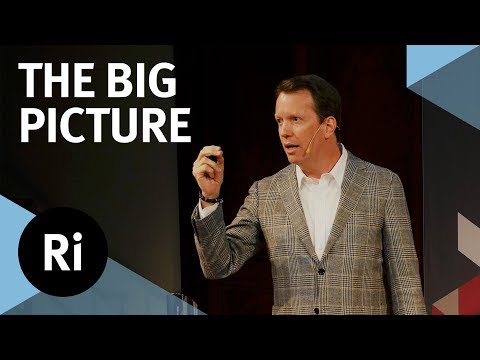
The Big Picture: From the Big Bang to the Meaning of Life - with Sean Carroll
The Royal Institution
Summary
Sean Carroll argues that while fundamental physics operates on patterns and differential equations, not cause-and-effect or inherent purpose, these concepts emerge at macroscopic levels, allowing for free will and meaning within a scientifically understood, finite existence.
Key Takeaways
- Shift from Aristotelian Causality to Patterns: Fundamental physics moved from Aristotle's view of natural states and external movers to modern descriptions where constant motion is natural (inertia), and the universe is governed by mathematical patterns and differential equations that predict both past and future, rather than cause-and-effect relationships. 13:16
- Known Core Theory for Everyday Life: The laws of physics underlying everyday life, involving particles like electrons, quarks, and neutrinos, and four fundamental forces (gravity, electromagnetism, strong, weak), are completely known and accurately describe phenomena from human biology to the motion of objects, unlikely to be overturned by future discoveries. 16:41
- Emergence Explains Macroscopic Reality: Concepts like cause-and-effect, purpose, and natural states, though not fundamental to the core theory, are accurate and useful "emergent vocabularies" for describing the world at different, higher levels of analysis, allowing us to reconcile physics with our everyday experience. 7:11
- Arrow of Time from Low Entropy Past: The observed distinction between past and future (the "arrow of time") is not an inherent feature of fundamental physical laws, which are time-symmetric, but arises from the universe's exceptionally low-entropy state at the Big Bang and the subsequent, irreversible tendency of entropy to increase. 30:10
- Complexity from Increasing Entropy: The universe's natural progression toward higher entropy allows for the emergence of complexity; as entropy increases, complexity first rises (e.g., forming galaxies, stars, life) and then eventually decreases as the universe becomes maximally disordered. 37:19
- Consciousness and Free Will are Emergent: Consciousness, thoughts, and the ability to make choices are not incompatible with the physical laws of the core theory but are emergent properties of complex systems like the brain, describable at higher levels of abstraction within a framework called "poetic naturalism." 55:35
- Meaning and Morality are Constructed: Objective moral truths or inherent purpose are not found within the fundamental laws of physics; instead, meaning, values, and right from wrong are human-constructed frameworks, akin to the rules of a game like chess, that we create and agree upon based on shared goals. 57:54
- Embrace Finite Existence: Recognizing human life's finite nature and humanity's non-central place in the vast universe should not lead to despair but rather empower individuals to make conscious choices, care for others, and create meaning, as these capacities are unique emergent features of our existence. 1:00:19